Open-loop prepaid cards
Carry a Visa or Mastercard logo and a 16-digit number. Accepted anywhere that network is taken. These are the cards the MyGift portal is built for, and the ones that need a registered address for online use.
A plain-English reference for people holding a Gift Card Mall prepaid Visa or Mastercard gift card: how to read your balance, why online checkouts reject the card, what the fees really mean, and how to spend the last few dollars instead of losing them.
MyGiftGitCard is an independent educational resource. We are not affiliated with, endorsed by, or connected to Gift Card Mall, MyGift, Blackhawk Network, Visa, or Mastercard. We do not sell, issue, activate, or service gift cards, and we will never ask you for a card number, CVV, or PIN. To manage a real card, use only the website and phone number printed on the card itself.
The basics
The phrase gets typed into search bars millions of times a year, usually by someone who has just been handed a gift card and wants to know what is on it. It is not one product but two related things. Gift Card Mall is a retail brand operated by Blackhawk Network that sells gift cards — both open-loop prepaid Visa and Mastercard cards that work almost anywhere, and closed-loop store cards for a specific retailer. MyGift is the self-service portal for people who already hold one of those prepaid cards.
Everything a cardholder normally needs happens in that portal: reading the balance, seeing where the card has been spent, and registering a billing address so the card survives an online checkout. It is worth understanding the difference between the two card types, because almost every confusion people have traces back to it.
Carry a Visa or Mastercard logo and a 16-digit number. Accepted anywhere that network is taken. These are the cards the MyGift portal is built for, and the ones that need a registered address for online use.
Branded for a single retailer and spendable only there. They have their own balance-check page run by that retailer — the MyGift portal cannot look them up, which surprises a lot of people.
No PIN, no ATM access, no cash back, no reloading, no overdraft. The card holds a fixed amount of money and stops working when that money is gone. Everything below follows from this.
Step by step
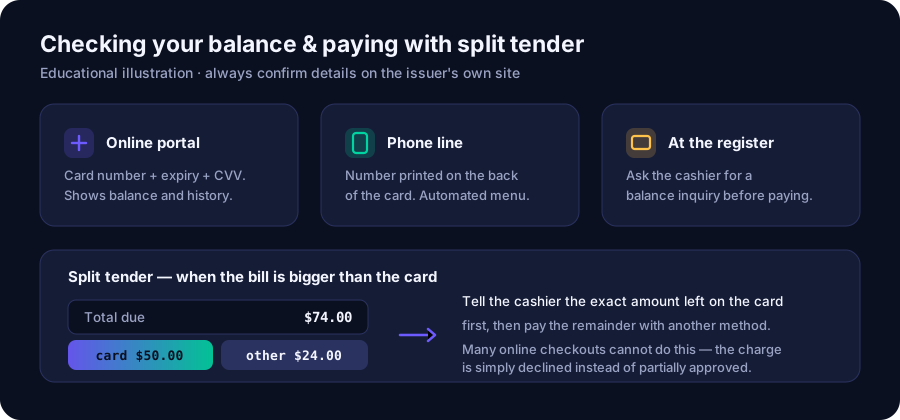
You have three routes, and they do not all show the same thing. Online is the most informative: the portal shows the available balance plus a transaction history, which is the only way to see whether a pending hold is eating into your funds. By phone, the number on the back of the card reads the balance through an automated menu — fine if you just want a figure. At the register, a cashier can run a balance inquiry before ringing you up, which is the fastest option when you are already standing in the store.
Whichever route you take, you will need three pieces of information from the card: the 16-digit number on the front, the expiry date, and the 3-digit security code on the back. One habit is worth building here — always type the portal address by hand, reading it off the physical card. Fake balance-check sites buy search ads against this exact phrase, and the only thing they do with a card number and CVV is drain the card.
One more distinction that causes real frustration: the starting value is what was loaded onto the card, while the available balance is what you can actually spend right now. A restaurant that added a 20% tip hold, or a gas pump that pre-authorised $100 for a $30 fill-up, will make those two numbers disagree for a day or three until the hold settles.
Activation & registration
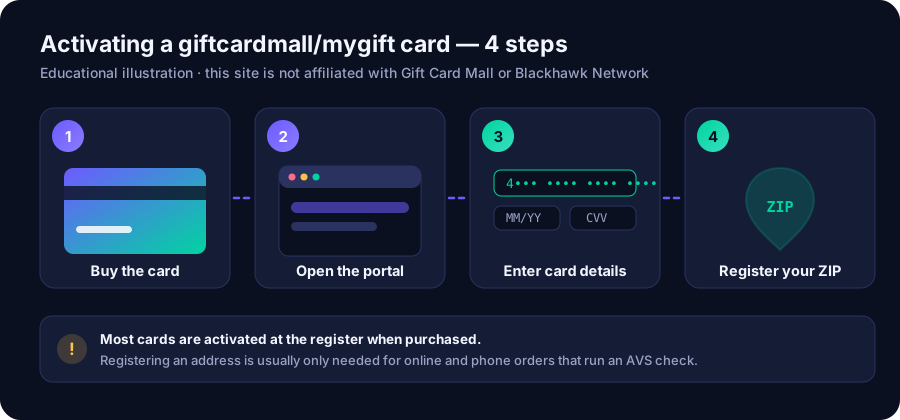
These are two different things, and conflating them is the root of an enormous amount of confusion. Activation happens at the register when the card is purchased — the cashier scans it, the funds load, and the card is live. You almost never need to do anything. Registration is you attaching a name, ZIP code, and street address to the card, and it exists purely so that online merchants can run an address verification check against it.
If you only ever use the card in physical stores, you can skip registration entirely. The moment you want to buy something online, register first — otherwise the address check has nothing to compare against and the payment fails, usually with a generic error message that tells you nothing useful.
The purchase receipt is the single most valuable piece of paper attached to a gift card. It is the proof that the card was paid for and activated, and it is the first thing customer service asks for if the card ever reads as inactive or goes missing. Photograph the receipt and both sides of the card when you get it — thirty seconds of effort that turns an unrecoverable loss into a replaceable one.
Spending it
Open-loop prepaid cards work at online checkouts, but they behave slightly differently from a normal debit card, and a few habits make the difference between a smooth purchase and a mystifying decline.
Residual balances are where gift card value quietly dies. Billions of dollars sit unspent on cards with awkward leftovers like $3.47. In a physical store you can defeat this with split tender: check the exact balance, tell the cashier "please put $3.47 on this card first", and pay the rest with another method. Say it before they ring the transaction, because many terminals cannot split after the fact. Online, the reliable workaround is to buy a digital store gift card for exactly the remaining balance and spend that instead.
Troubleshooting
A declined gift card almost never means the card is broken. In nearly every case it is one of a small set of predictable causes, and the error message the merchant shows you is usually too generic to tell you which. Work down this table from the top; the first two rows account for most cases.
| Symptom | Most likely cause | What to do |
|---|---|---|
| Declined at an online checkout | No billing address registered to the card. | Register your ZIP code and street address in the portal, then retry. Use the same address the merchant has on file. |
| Declined but balance looks fine | Purchase total exceeds the available balance, or a pending hold is tying up funds. | Check the available balance, not just the starting value. Wait 24–72 hours for stale authorisations to drop off. |
| Terminal asks for a PIN | The card is being run as debit. | Ask the cashier to process it as credit. There is no PIN on these cards. |
| Gas pump rejects the card | Pumps pre-authorise a large amount before dispensing. | Pay inside at the counter for an exact amount instead of at the pump. |
| Restaurant charge is higher than expected | Restaurants add an automatic tip hold, often 20%. | Keep a buffer above the bill, or pay the tip separately in cash. |
| Card reads as inactive | Activation did not complete at the register. | Call the issuer with your purchase receipt. The receipt is what proves the card was paid for. |
| Hotel or rental car declines it | Those merchants place a large refundable hold on the card. | Use another card for the deposit and present the gift card at final checkout. |
Money
Fees on prepaid gift cards are more constrained than most people assume, because the US CARD Act of 2009 set federal floors that every issuer has to meet. Knowing them stops you from being talked into worrying about charges that legally cannot happen.
The authoritative source for your particular card is the packaging insert it came in and the cardholder agreement linked from the issuer's own site. Fee schedules vary between card programs and change over time, so treat this section as orientation rather than as the terms governing your card.
Protect yourself
Gift cards are the payment method of choice for fraud, for one structural reason: once someone has the card number and CVV, the money is gone and there is no chargeback mechanism to claw it back. It behaves like cash. Two categories of scam account for most losses.
No legitimate organisation — not the IRS, a utility, your bank, law enforcement, a court, or your employer — will ever ask to be paid in gift cards. Neither will a real romantic partner or a real tech support agent. This demand is, without exception, a scam. Stop and verify through a number you looked up yourself.
Lookalike sites buy ads against searches like this one, then harvest the card number and CVV you type in. Reach the portal only by typing the address printed on your physical card. No legitimate balance check ever asks for your SSN, bank login, or a payment.
Thieves record numbers from cards on display, then drain them the moment they are activated. Inspect the packaging for peeled stickers, scratched PIN panels, or a resealed back, and prefer cards from behind the counter.
If you have already sent a card number to someone you now suspect is a scammer, call the issuer immediately using the number on your receipt — occasionally funds can be frozen if the card has not yet been drained. In the United States, report it to the FTC at reportfraud.ftc.gov.
Answers
It is the shorthand people use for the cardholder portal operated by Gift Card Mall, a Blackhawk Network brand. The portal lets someone holding a prepaid Visa or Mastercard gift card look up the remaining balance, review transaction history, and register a billing address so the card works at online checkouts. "Gift Card Mall" is the store that sells the cards; "MyGift" is the self-service area for people who already hold one.
There are three reliable routes. Online, open the official portal printed on your card packaging and enter the 16-digit card number, expiry date, and CVV. By phone, call the toll-free number on the back of the card and follow the automated menu. In person, ask a cashier to run a balance inquiry before you pay. Balances update within seconds of a purchase, though a pending authorisation from a restaurant or gas pump can make the available balance look lower for a day or two.
In most cases the card is activated by the cashier at the moment of purchase, so no separate step is needed. Keep the receipt — it is the proof of activation, and customer service will ask for it if the card ever reads as inactive. What people usually mean by "activating" is registering a ZIP code or billing address, which is a different step and is only required for online, phone, and mail-order purchases.
The single most common cause is that no billing address is registered to the card, so the merchant's address verification check fails. The second most common is that the purchase total exceeds the remaining balance — most websites cannot split a payment across two cards, so the whole charge is declined rather than partially approved. Other causes include a merchant pre-authorising more than the ticket amount (hotels, gas pumps, and rental cars routinely hold extra), a subscription or recurring billing that prepaid cards are not permitted to fund, and an expired card.
No. These are gift cards, not debit cards. They are not issued with a PIN for cash access, so ATM withdrawals and cash-back at the register are not supported. If a checkout asks for a PIN, choose the "credit" option instead, or ask the cashier to run it as credit.
Small residual balances are the most commonly wasted part of any gift card. In a physical store you can use split tender: tell the cashier the exact remaining amount before they ring you up, pay that portion on the gift card, and cover the rest with another method. Online, the practical trick is to buy a store gift card for exactly the remaining balance, then spend that. Reloading a Gift Card Mall gift card is not supported.
Under the US CARD Act, funds on a gift card cannot expire for at least five years from the date the money was loaded, and inactivity fees cannot be charged in the first twelve months. The plastic itself carries a printed expiry date that usually arrives sooner than the funds do; if the card expires while money remains, the issuer is required to provide a replacement, sometimes for a fee. Fee terms vary by card, so read the packaging insert that came with yours rather than assuming.
No. This site is an independent, educational reference. It is not operated by, endorsed by, or affiliated with Gift Card Mall, MyGift, Blackhawk Network, Visa, or Mastercard. We never ask for card numbers, and we cannot look up balances, issue refunds, or resolve account problems. For anything involving your actual card, use the phone number and web address printed on the card itself.
Often not, and where it works it is fragile. Recurring billing requires the merchant to store the card and charge it indefinitely; many services reject prepaid BINs outright at sign-up. Even when the first charge succeeds, the subscription fails the moment the balance runs below the monthly fee, which can interrupt service. Treat these cards as best suited to one-time purchases.
Call the number on your receipt or packaging immediately and have the card number and purchase receipt ready. Replacement is generally possible only if you can supply the card number, which is why photographing the front and back of the card when you receive it is worth the thirty seconds. Without the card number, a lost gift card is usually treated like lost cash.